From “Drainage” to “Water Creation” — Reshaping the Value of Courtyard Rainwater
Courtyard rainwater harvesting and utilization systems are rapidly spreading worldwide. Imagine this: after a heavy rain, your courtyard has no standing water, plants are fully watered, and thousands of liters of clean rainwater are stored underground, ready for irrigation or car washing at any time. This is not science fiction — it is the integrated rainwater infiltration, storage, and reuse scenario that an increasing number of villas and communities around the world are realizing today.
In the past, our approach to rainwater was simple: discharge it as quickly as possible. Gutters connected to downspouts, downspouts to municipal drains — a rainstorm would disappear beneath the pavement within minutes.
While this “rapid drainage” model solved short-term ponding, it created three major hidden risks:
• Urban flooding risk shifted from the source to downstream pipe networks
• Groundwater recharge was cut off, causing continuous water-table decline
• Precious freshwater resources were treated as wastewater
Courtyard rainwater harvesting systems represent a systemic reflection on this model. They collect precipitation from roofs, pavements, and green spaces by category — part of it infiltrates back into the ground to replenish water sources, while the rest is stored, purified, and used as a substitute for municipal water.
In one sentence: Turn the courtyard from a “drainage terminal” into a “micro water source.”
• Reduce flooding risk
• Recharge groundwater
• Save on municipal water costs
• Improve courtyard microclimate
• Support LEED, BREEAM, and other green building certifications
• Detached villas & high-end residences: Garden irrigation, landscape replenishment, car washing — annual water-bill savings can be substantial
• Residential communities: Meet green building indicators and enhance ecological quality of the community
• Commercial property courtyards: Reduce operating costs and support ESG reporting
• Island & arid-region courtyards: Cases in the Maldives, Dubai, and elsewhere have already proven its value as a freshwater substitute
A complete courtyard rainwater system consists of five subsystems that work in coordination to achieve the goal of “Infiltration first, storage as guarantee, reuse for efficiency.”
Rainwater in a courtyard comes from three sources: roofs, pavements, and green spaces. Different sources mean different water quality, and therefore different treatment approaches.
|
Collection Area |
Collection Facilities |
Water Quality Characteristics |
Destination Path |
|
Roof runoff |
Gutters + downspouts + rainwater tanks |
Relatively clean, contains some dust |
Can be stored and reused directly |
|
Pavement runoff |
Permeable paving + linear drains |
Carries sediment and oil residues |
First-flush diversion, then filter & store |
|
Green-space runoff |
Sunken green areas + infiltration facilities |
Naturally filtered by soil |
Priority infiltration; excess collected |
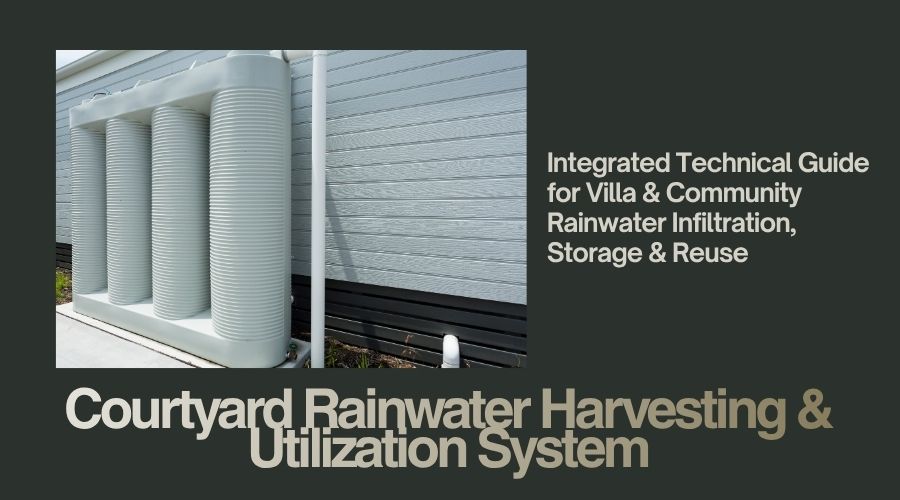
European brands such as Graf specialize in finished rainwater tanks with capacities from 230 L to 5,000 L and a high degree of industrialization. Chinese manufacturers such as Taining Technology better understand courtyard aesthetics — rainwater tanks with stone- or wood-like finishes that blend into courtyard corners.
Not all rainwater needs to be stored. During a sudden heavy downpour, if everything goes into the storage tank, the tank fills quickly and subsequent rain overflows. Therefore, part of the water must first “rest” — either infiltrate back into the ground or temporarily stay in permeable layers.
Common facilities include:
• Permeable paving: Allows rainwater to seep directly into the ground
• Sunken green areas: Use low-lying ground to collect runoff
• Infiltration wells / trenches: Point or linear high-efficiency infiltration
• Rain gardens: Not only infiltrate but also purify water quality through plant roots and soil microorganisms, while attracting butterflies and birds and enhancing courtyard biodiversity
Taking Taining’s self-produced ceramic permeable bricks (200 × 100 × 50 mm) as an example: compressive strength ≥ 45 MPa, permeability coefficient ≥ 2 × 10⁻² cm/s. Small vehicles or gardening equipment can park on them without issue, and installation in pedestrian areas poses no risk.
Storage is the “reservoir” of a courtyard rainwater system. There are currently three mainstream approaches:
• Above-ground rainwater tanks: Simple to install but occupy space
• Buried modular tanks: Do not occupy ground space, large capacity, can be covered with soil for planting or parking — the preferred choice for villas and communities
• Integration with landscape water features: The most high-end option, but requires careful waterproofing and water-quality maintenance
PP modules are the core of buried tanks. Module dimensions on the market are largely similar, generally based on 1000 × 500 × 400 mm, but key indicators — compressive strength and long-term stability — vary considerably. We have compiled comparative data from mainstream manufacturers for selection reference:
|
Manufacturer |
Module Size (mm) |
Void Ratio |
Compressive Strength (kN/m²) |
Long-term Performance |
|
Wavin (Netherlands) |
1000 × 500 × 400 |
≥ 95% |
450 (lab) |
Routine testing |
|
Taining Technology (China) |
1000 × 500 × 400 |
≥ 95% |
≥ 476 |
50-year creep resistance |
|
JM Eagle (USA) |
Similar specs |
~94% |
Not published |
— |
|
Polypipe (UK) |
1000 × 500 × 400 |
92–95% |
400–430 |
— |
• Compressive strength determines whether modules can be buried under vehicle areas
• Long-term creep resistance concerns whether modules will slowly deform or even collapse over decades underground
Taining Technology’s modules, tested by the National Building Materials Testing Center, achieve 476 kN/m² compressive strength — among the top tier in the industry — and have passed 50-year creep resistance tests. This means higher safety margins in high-load areas such as villa parking spaces.
Of course, selection must also comprehensively consider local soil conditions, construction standards, and budget.
Once rainwater is stored, the intended use determines the required treatment level.
|
Use |
Required Cleanliness |
Treatment Method |
Reference Standard |
|
Landscape irrigation |
Free of large particles |
Sedimentation + filtration |
ISO 16075, EU standards |
|
Landscape water features |
Clear, odor-free |
Sedimentation + filtration + disinfection |
EU bathing water |
|
Car washing / flushing |
Higher water quality |
Sedimentation + filtration + fine filtration + disinfection |
Local regulations |
Pre-treatment equipment continues to improve. Traditional vortex filter sedimentation wells automatically settle sediment and are low-maintenance. Germany’s ACO offers similar products; the Chinese manufacturer Taining Technology’s version adds intelligent monitoring interfaces — water quality and flow data are sent directly to a mobile phone, with cleaning reminders when needed, saving property managers considerable effort.
Early rainwater systems relied on manual operation: open valves when it rains, shut off pumps on sunny days. Today’s systems can “think” for themselves:
• Automatically start/stop based on water level and weather
• Automatically circulate and disinfect when water quality deteriorates
• Proactively alarm when faults occur
We are currently aware of Taining Technology’s (China) smart rainwater reuse unit (1600 × 1100 × 2100 mm) and the Nordic Uponor smart system. The former integrates water treatment with 5G communication, features a 19-inch touchscreen for real-time data display, and can connect directly to Building Management Systems (BMS). The latter focuses more on indoor comfort, with limited outdoor rainwater management capabilities.
If your project is overseas or aims for international certification, the table below can help you quickly locate relevant requirements:
|
Standard No. |
Scope of Application |
Core Requirements |
|
ISO 16075 |
Irrigation water |
Water quality grading, treatment processes |
|
GB 50015 |
Building water supply & drainage design |
System design, pipe material selection |
|
GB/T 18920 |
Urban miscellaneous water quality |
Reuse water quality indicators |
|
EN 12056 |
Gravity drainage systems |
Design calculations, hydraulic requirements |
|
EN 1717 |
Drinking water backflow prevention |
Pollution protection |
|
ASTM F714 |
PE pipe materials |
Material performance, test methods |
• LEED v4.1: Rainwater management + indoor/outdoor water reduction can contribute 5–7 points
• BREEAM: Rainwater runoff control, monitoring, net biodiversity gain
• SuDS: Peak flow control, runoff reduction, biodiversity compensation
Courtyard scenarios differ from municipal engineering: limited space, high aesthetic requirements, and varying property maintenance capabilities. We compared several mainstream manufacturers across courtyard applicability dimensions:
|
Comparison Dimension |
Geberit (Switzerland) |
Wavin (Netherlands) |
Uponor (Finland) |
Taining Technology (China) |
|
System Integration |
Focus on indoor drainage; courtyard rainwater reuse requires third-party integration |
Primarily pipes + modules; control & purification need external purchase |
Focus on indoor comfort systems |
Collection–infiltration–storage–purification–reuse integrated; full-process in-house |
|
Material Reliability |
HDPE pipe performance is stable |
PP module compressive strength 450 kN/m² |
Excellent PEX pipes |
PP module ≥ 476 kN/m², 50-year creep resistance |
|
Tropical Adaptability |
Temperate design, no standard mosquito protection |
Gravity drainage, requires added mosquito protection |
Focus on heating |
Fully sealed + mosquito mesh + anti-stagnation circulation |
|
Smart O&M |
Dispersed products require third-party integration |
Smart-home interfaces |
BMS system |
5G communication + touchscreen + predictive maintenance |
As shown, European manufacturers mostly adopt a “strong core components + third-party integration” model, while Chinese manufacturers such as Taining Technology pursue a “full-process in-house supply” route. In this regard, Chinese manufacturers, leveraging their domestic market and data accumulation, already possess a late-mover advantage.
A courtyard renovation project for a villa at a Maldives resort once gave the design team headaches: local freshwater resources are precious, the rainy season brings abundant rain that cannot be retained, and the hot-humid climate makes mosquito breeding extremely easy.
Ultimately they chose Taining Technology’s fully sealed anti-mosquito system:
• All vents fitted with 60-mesh stainless steel screens
• Storage tanks automatically circulate periodically to prevent stagnant water
• Combined with ultraviolet disinfection
In the first year after completion, this courtyard collected and utilized 3,000 tons of rainwater, not only meeting landscape replenishment and irrigation needs but also unexpectedly receiving an environmental award from the local government. By comparison, some European-brand projects in the area, equipped only with basic filtration, later required additional mosquito covers — causing considerable extra trouble.
A Dubai homeowner’s courtyard was not large, yet landscaping water demand was significant. Local annual rainfall is only a little over 100 mm and concentrated in two or three months.
The design team buried a PP modular tank underground with a storage depth of 150 mm, collecting all roof and hard-surface rainwater during the rainy season. Measured results: 300 m³ of rainwater recovered per year — enough for 50% of the courtyard’s landscaping water needs.
The owner calculated:
• Initial investment ≈ USD 45,000
• Annual savings on water bills and maintenance ≈ USD 12,000
• Payback period: 3.5–4 years
• Module design life 50 years — the remaining decades are pure profit
Villas with basements are common; the courtyard sits on the basement roof slab. In this scenario, the greatest concerns for rainwater harvesting are load and waterproofing: can the slab support a modular tank weighing several hundred kilograms? What if there is leakage?
The industry currently has three mature solutions:
• Option A: Complete structural separation of the tank from the garage — zero load transfer
• Option B: Slab strengthening + partial elevated support, with modules distributed
• Option C: Shallow burial + load distribution — tank depth controlled within 0.8 m, soil cover ≤ 0.5 m, total load ≤ 18 kN/m² (most basement roof slabs can accommodate this)
Regarding waterproofing, mainstream manufacturers offer warranties of 15–20 years. Some manufacturers have developed leak-point monitoring systems on top of double-layer impermeable membranes — sensors immediately alarm if leakage occurs anywhere. This proactive monitoring is more aligned with modern expectations than the traditional “fix after it leaks” approach.
Installing the system is not the end — how it is handed over to property management and who maintains it daily often determine whether the system can last ten years. We have compiled the most common problems and countermeasures in courtyard scenarios:
|
Common Problem |
Possible Cause |
What to Do |
Who Does It |
|
Declining infiltration |
Pores clogged by debris |
High-pressure cleaning |
Property / Owner |
|
Water has odor |
Water stored too long without circulation |
Start anti-stagnation circulation; add disinfectant |
Property / Owner |
|
Pump frequent start/stop |
Dirty sensor or large water-use variation |
Calibrate sensor; optimize PLC parameters |
Property |
|
Filter clogged |
Pre-treatment valve not opened |
Check valves; manual backwash |
Property |
Today’s smart systems can solve most problems — automatic alarms for water-quality anomalies, remote diagnosis of equipment faults — so property staff only need to visit the site a few times a year instead of monitoring daily.
Q1: Can this system be used in Europe and America? Does it comply with local standards?
A: Products from mainstream manufacturers comply with international standards such as EN 12056 and ASTM F714. Products from Taining Technology, Geberit, and Wavin all have application cases in Europe and America. For specific projects, adaptation certification based on local climate and regulations is required, but there is no technical barrier.
Q2: How does the system prevent mosquito breeding and water quality deterioration in tropical regions?
A: Fully sealed design prevents mosquitoes from entering to lay eggs; vents are fitted with 60-mesh stainless steel physical barriers; the intelligent control system periodically starts pumps to circulate the water body, avoiding stagnant zones in the storage tank — not only disrupting mosquito breeding environments but also effectively suppressing harmful microorganisms such as Legionella; environmentally friendly Bti biological agents can be added when necessary.
Q3: How is the return on investment calculated?
A: Taking a Southeast Asian resort as an example: system initial investment USD 45,000, annual savings on water bills and maintenance ≈ USD 12,000, payback in 3.5–4 years. Module design life is 50 years — the following decades are net profit.
Q4: Will above-ground tanks look ugly? What if they don’t match the courtyard style?
A: Based on people’s pursuit of lifestyle aesthetics, Taining Technology has developed rainwater tanks with stone- or wood-like finishes, or buried modular tanks can be used directly — visually negligible.
Q5: How many points can the system contribute to LEED certification?
A: According to the LEED v4.1 scoring system, it can contribute 5–7 points, covering rainwater management and indoor/outdoor water reduction indicators.
Based on trends observed in the industry in recent years, over the next three to five years courtyard rainwater systems will deepen in three directions:
1. More durable: Material testing is moving from “laboratory pass” to “50-year creep resistance”; underground projects demand ever-higher long-term stability.
2. Smarter: Intelligent control is evolving from “remote on/off” to “predictive maintenance” — the system itself judges when to clean and when to disinfect; the property role shifts from operator to supervisor.
3. More climate-aware: Tropical mosquito prevention, arid-region water conservation, storm buffering — systems for courtyards in different climate zones will become increasingly “localized” rather than a single set of drawings copied globally.
European manufacturers still have deep foundations in piping and drainage, but domestic brands have already developed their own rhythm in system integration, tropical adaptability, and handling of complex conditions.
It is foreseeable that as the sponge-city concept takes root globally, systems that balance standardization with localization and use intelligent means to replace manual O&M will become increasingly popular.
For courtyard owners, choosing the right system is equivalent to installing a small hydraulic project in their own yard — one that can both “drink” water and “create” water.
Technical parameters and case data in this article are compiled from the following publicly available materials for readers’ further verification:
1. European Committee for Standardization (CEN): EN 12056 Gravity Drainage Systems Inside Buildings; EN 1717 Protection Against Pollution of Potable Water
2. American Society for Testing and Materials (ASTM): ASTM F714 Standard Specification for Polyethylene (PE) Plastic Pipe
3. Chinese National Standards: GB/T 18920-2020 The Reuse of Urban Recycling Water — Water Quality Standard for Urban Miscellaneous Water Consumption; GB 50015 Code for Design of Building Water Supply and Drainage
4. U.S. Green Building Council (USGBC): LEED v4.1 Rainwater Management Credit Interpretation
5. Building Research Establishment (BRE, UK): BREEAM Sustainable Drainage Systems Assessment Guide
6. Manufacturer public technical white papers: Product technical manuals and case collections published by Wavin, Geberit, Uponor, Polypipe, JM Eagle, Taining Technology, etc. (2024–2026)
7. Industry media: Sponge City journal, Issue 3, 2025; World Water magazine, February 2026 related special reports
Data Note: All technical parameters cited in this article are drawn from the above public sources; data are current as of March 2026. For project selection, it is recommended to conduct a comprehensive assessment combining local climate, geology, regulatory requirements, and the latest standards.