
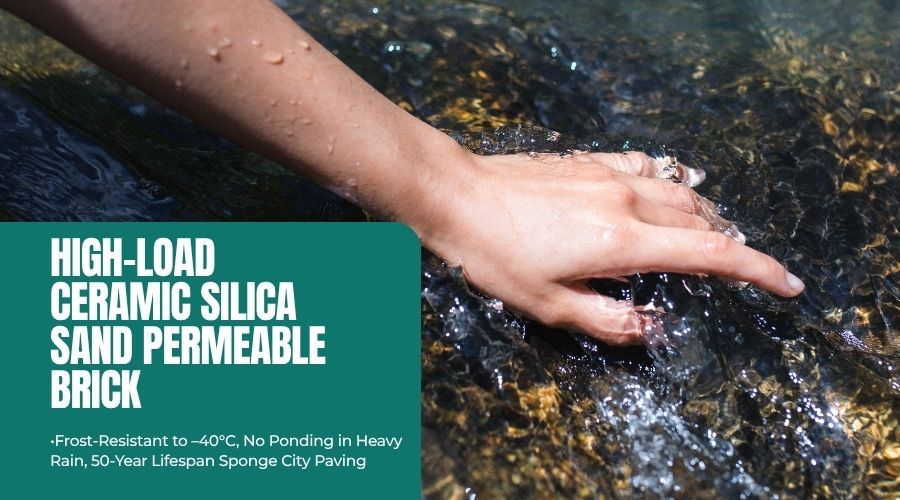
Ceramic silica sand permeable brick is a high-load permeable paving material specifically designed for sponge cities and extreme climates.
Imagine this: after a heavy rainstorm, the pavement has no standing water—rainwater rapidly seeps into the ground. At noon in summer, the surface temperature is more than 20°C lower than the adjacent asphalt road, so you can walk barefoot without burning your feet. This is not science fiction; it is the “breathing pavement” that more and more cities around the world are realizing today. The core material is ceramic silica sand permeable brick.
Core Performance: Compressive strength ≥45 MPa, permeability 20 mm/s, no damage after 25 freeze-thaw cycles at –40°C, surface temperature 20–25°C lower than asphalt, runoff control rate ≥85% under a 50-year return period storm, service life exceeding 50 years.
As one of the earliest enterprises in China engaged in the R&D of permeable paving, we have learned over 20 years of practice that a good permeable brick must not only “permeate water” but also “withstand” extreme weather. From severe freeze-thaw conditions in the north, to heavy-rain flooding in the south, to arid heat in the Middle East—we have seen too many cases of cement permeable bricks failing after only a few years of service. These lessons led us to focus on high-temperature sintered ceramic materials.
The permeable ecological ground system takes high-load ceramic silica sand permeable brick as its core product, following the principles of “infiltrate, detain, store, and purify.” While meeting load-bearing requirements, it restores the soil–atmosphere–vegetation water cycle. This system is suitable not only for sidewalks, plazas, parking lots, and residential communities, but can also perform stably under extreme climatic conditions—this is precisely where its value differs from ordinary permeable paving.
Ten years ago, we first tried using cement permeable bricks on a project in northern China. That winter was exceptionally cold. When we revisited the site the following spring, we found extensive freeze cracking on the paved surface—some bricks had even shattered into pieces.
The client asked us: “You said it could permeate water, but you didn’t say it would freeze and break.”
That lesson made us realize that both “permeability” and “durability” of permeable bricks must be solved simultaneously. Back in the laboratory, we began studying the closed-pore structure of sintered ceramics.
The secret of this structure is: after high-temperature sintering at 1,200–1,300°C, a large number of closed pores form inside the material, preventing water molecules from entering. Freeze-expansion stress has nowhere to act, so damage naturally does not occur.
Based on this discovery, we spent five years optimizing the raw-material ratio and sintering process to create today’s ceramic silica sand permeable brick.
Selected ceramic raw materials and silica sand are used. After particle screening and grading, the mix is formed under 1,600-ton high-pressure molding and then high-temperature sintered (1,200–1,300°C for 8–12 hours). The sintering process uses a stepped heating curve, with a 1–2 hour hold in the 800–900°C range to fully burn out the pore-forming agent, ultimately forming a mullite-phase crystal-bridge connected structure.
This sounds contradictory, but the principle is simple.
Permeability relies on open pores (commonly called “permeation channels”). Open porosity is 20%–25%, with pore diameters of 50–200 μm. Rainwater rapidly infiltrates through these channels.
Durability relies on closed pores (commonly called the “waterproof barrier”). Water absorption rate ≤0.5%; water molecules cannot enter, so the brick naturally resists freezing damage.
One brick serves two purposes; the key lies in precise control of sintering temperature.
Measured permeability coefficient ≥2.0×10⁻² cm/s—converted, 20 mm/s means that 1 square meter of brick surface can infiltrate 20 liters of water per second, equivalent to a bucket of bottled water disappearing into the ground in the blink of an eye.
We conducted a test: half of a batch of bricks were polished and half left as-is. After being wetted, people walked on them. The polished bricks were noticeably slippery, while the unpolished bricks remained steady.
The reason is that the surface of ceramic silica sand permeable brick forms a micro-rough structure through particle grading, and we deliberately avoid glazing treatment.
Dry BPN ≥70, wet BPN ≥60—these figures mean that even in heavy rain, walking on the surface feels as stable as on a clear day.
After 25 freeze-thaw cycles according to ASTM C67, mass loss ≤0.5% and compressive strength retention ≥95%. How were these data obtained? We sent the bricks to the National Building Materials Testing Center, where they were repeatedly frozen and thawed to reach the final conclusion.
Even more convincing are the on-site follow-ups.
Ten-year tracking observations in Calgary, Canada (winter –35°C) and Harbin, China (winter –32°C) show: no freeze cracking or spalling on the brick surface, and permeability coefficient retention ≥85%. On the same street, areas paved with cement permeable bricks had already lost 40%–60% of their permeability after 10 years.
In the summer of 2022, Beijing experienced consecutive days of 40°C heat. We measured a set of data in the Olympic Central Area:
• Asphalt pavement temperature: 65°C
• Ordinary concrete pavement: 55°C
• Ceramic silica sand permeable brick: 35°C
Why such a large difference? Three reasons:
1. Continuous heat absorption through evaporation of moisture inside the brick
2. Much higher reflectivity of the light-colored surface compared with dark materials
3. The permeable structure allows cool air from below to rise by convection—equivalent to a built-in “air conditioner” for the ground
On the day Typhoon Bebinca made landfall in Shanghai in 2024, our engineers stood in rain boots on the permeable paving area of the Hongqiao Business District. The rain was so heavy that umbrellas could not be held open, yet the pavement underfoot never ponded.
A colleague standing on the asphalt road next door messaged: the water was already over the ankles.
Combined with a permeable base layer (permeable concrete + graded crushed stone), ceramic silica sand permeable brick achieves a runoff control rate of 85%–90% under a 50-year return period storm (90 mm/h), with peak delay of 15–30 minutes.
This means it not only keeps itself free of ponding but also helps municipal drainage networks “catch a breath.”
We conducted an extreme drying test: bricks were placed in a 70°C oven for 90 consecutive days. Upon inspection after removal—no cracking or deformation whatsoever.
The structural stability of sintered ceramic means it does not fear drying shrinkage. This is especially important in arid and semi-arid regions, because cement-based materials tend to crack after prolonged drying, whereas ceramic does not.
In 2023, we received feedback from a project in Singapore: after three years of installation, the permeable brick surface showed no algae or mold attachment. Adjacent cement permeable brick areas had already turned green.
The reason is simple: a ceramic surface fired at 1,200°C contains no nutrients. Mold and algae have nowhere to take hold.
Comparative tests show: cement permeable bricks develop visible algae within 3–6 months, while ceramic permeable bricks remain clean after 12 months.
Ceramic silica sand permeable brick itself does not grow moss—this is determined by high-temperature sintering. However, if fallen leaves and dust are not cleaned for a long time, organic matter can grow moss under humid conditions.
The solution is simple: quarterly sweeping and annual high-pressure washing. After ten years, permeability can still be maintained above 70%.
Source: Leader in Permeable Ecological Ground Systems — Tidelion
Many people ask: is it true that 75%–85% of your bricks are industrial waste?
This story begins in 2010. That year we visited several ceramic factories in Hebei and saw mountains of waste blanks, waste bricks, and cutting scraps piled in the plant areas—called “waste” in the ceramic industry, but “treasure” in our eyes.
We began studying how to crush, screen, and reuse these wastes. After several years, the formula stabilized. Each square meter of brick can absorb 120–150 kg of solid waste.
For a 100,000 m² project, that means processing 12,000–15,000 tons of industrial waste. This is not only business; it is responsibility.
|
Raw Material Category |
Main Components |
Mass Ratio |
Function |
Circular Economy Attribute |
|
Aggregate |
Silica sand, ceramic waste, coal gangue |
75%–85% |
Skeleton and permeation channels |
Industrial solid waste utilization |
|
Binder |
Kaolin, bentonite |
10%–15% |
Melt-sintering and forming |
Natural minerals |
|
Flux |
Feldspar, talc |
3%–5% |
Lower sintering temperature |
Energy saving and consumption reduction |
|
Pore-forming Agent |
Carbon powder, wood chips |
1%–2% |
Regulate porosity |
Biomass waste |
|
Colorant |
Inorganic pigments |
0.5%–2% |
Color stability |
Non-toxic and eco-friendly |
Note: Ceramic waste refers to green-body waste, fired rejects, and architectural ceramic cutting scraps generated during ceramic production. After crushing and screening, particle size is controlled within 0.5–3 mm to ensure continuity with the silica sand grading.
Raw material screening → Batch mixing → High-pressure forming → Drying → High-temperature sintering (1,200–1,300°C) → Finished product inspection
With a 50-year service life, the annual carbon emission per unit area is ≤4.0 kg CO₂e / m² / year, lower than that of cement permeable bricks and permeable asphalt.
Source: Leader in Permeable Ecological Ground Systems — Tidelion
4. Surface layer: Ceramic silica sand permeable brick (50–60 mm)
5. Leveling layer: Coarse sand / stone chips (30–50 mm)
6. Base layer: Permeable concrete or graded crushed stone (150–300 mm)
7. Cushion layer: Permeable crushed stone (100–200 mm)
8. Geotextile protection and compacted subgrade ≥93%
Levelness and compaction of the base layer are critical—we have seen too many projects where the base was not properly treated, resulting in settlement of the bricks within a few years. Therefore, it is better to spend two extra days making the base solid than to cut corners here.
After the bricks are laid, joints are filled with fine sand using interlocking laying.
Maintenance is simple: regularly sweep fallen leaves and dust; wipe oil stains with detergent; treat rust with oxalic acid; then rinse clean with high-pressure water.
|
Case |
Area |
Key Indicators |
On-Site Story |
|
Beijing Olympic Central Area Plaza |
50,000 m² |
Storm ponding ≤5 mm; infiltration completed within 30 min |
Built in 2008 and still in service; has withstood countless heavy rains without ponding |
|
Shanghai Hongqiao Business District |
80,000 m² |
Annual rainwater infiltration 60,000 m³ (≈26 standard swimming pools) |
During Typhoon Bebinca 2024 (112 mm/h): no ponding; adjacent asphalt road had ankle-deep water |
|
Xiong’an New Area Citizen Service Center |
Parking lot |
Runoff control rate 91.5%; summer surface temperature 6.2°C lower |
How hot is summer in Xiong’an? Asphalt can fry eggs; the permeable brick stays much cooler |
|
Environment / Need |
Recommended Solution |
Why Choose It |
|
Severe cold regions |
Ceramic silica sand permeable brick |
Closed-pore structure; frost-resistant to –40°C; 10-year tracking shows 85% permeability retention |
|
Extreme high-temperature regions |
Ceramic silica sand permeable brick |
Surface temperature 20–25°C lower than asphalt; built-in “air-conditioning” effect |
|
Heavy-rain-prone regions |
Ceramic silica sand permeable brick + permeable base |
Runoff control rate ≥85% under 50-year storm; helps drainage networks “catch a breath” |
|
Arid / semi-arid regions |
Ceramic silica sand permeable brick |
No cracking after 90 days of oven drying; cement bricks cannot achieve this |
|
Tropical high-humidity regions |
Ceramic silica sand permeable brick |
No algae attachment after 12 months; cement bricks turn green in 3–6 months |
|
High-density commercial areas |
Interlocking ceramic silica sand permeable brick |
High strength ≥50 MPa; suitable for pedestrians and parked vehicles |
|
Light vehicle roadways |
Interlocking ceramic silica sand permeable brick |
Structural joint permeability; overall load distribution; stable |
Q1: Can ceramic silica sand permeable brick support vehicles?
A: The standard type is fine for pedestrians. The interlocking type (structural-joint permeable brick) can support light vehicles and private-car parking. For heavy-duty lanes, permeable concrete or asphalt is recommended. We once repeatedly ran a 3-ton SUV over interlocking bricks; the bricks remained intact.
Q2: What if it becomes clogged?
A: Quarterly sweeping of leaves and annual high-pressure water washing are the basics. Wipe oil stains with detergent; treat rust with oxalic acid. After 10 years, permeability can still remain above 70%. On our Shanghai project after 8 years of use, permeability was still 80%.
Q3: Can it be used in the north? Will it freeze and break?
A: We have installations that have been in service for 10 years in Calgary, Canada and Harbin. They have endured winters of –35°C and –32°C year after year; the bricks have neither cracked nor spalled, and permeability remains above 85%. Cement bricks in the same period had already lost half their permeability.
Q4: Does it burn feet in summer?
A: Under direct noon sunlight, asphalt pavement reaches 65°C, ordinary concrete 55°C, and our brick 35°C. Which would you rather stand on? We measured this in the Beijing Olympic Central Area—data speak for themselves.
Q5: Will there be ponding in heavy rain?
A: With a permeable base layer, it can handle a 50-year return period storm (90 mm/h). During Typhoon Bebinca in 2024 (112 mm/h), the permeable paving area in Shanghai Hongqiao Business District had no ponding, while the adjacent asphalt road had 8–12 cm of water. Our engineers stood on site all afternoon with dry legs.
Q6: Will it crack if used in arid regions?
A: No. We placed bricks in a 70°C oven for 90 consecutive days; they came out completely intact. Sintered ceramic does not fear dryness—cement-based materials do.
Q7: Will it grow algae or mold in tropical regions?
A: On the Singapore project after 3 years, the surface remained clean. Adjacent cement bricks turned green within 3–6 months. The reason is simple: ceramic fired at 1,200°C contains no nutrients, so mold and algae have nowhere to take hold.
Q8: Will it grow moss?
A: The brick itself does not. However, fallen leaves and dust can grow moss under humid conditions. The solution is simple: sweep regularly and rinse with high-pressure water. This is a maintenance issue, not a brick issue.
Q9: How much does thermal comfort improve?
A: Evaporative cooling of 3–8°C, plus surrounding vegetation transpiration, improves perceived temperature by 5–10°C. We measured this in Xiong’an: at noon, the permeable brick surface is much cooler than the asphalt road.
Core Performance Recap: Compressive strength ≥45 MPa, permeability 20 mm/s, no damage after 25 freeze-thaw cycles at –40°C, surface temperature 20–25°C lower than asphalt, runoff control rate ≥85% under a 50-year storm, service life exceeding 50 years.
From the 50,000 m² paving of the Beijing Olympic Central Area Plaza in 2008 to facing Typhoon Bebinca in the Shanghai Hongqiao Business District in 2024, ceramic silica sand permeable brick has been in service for nearly 20 years. During these two decades, we have witnessed it remain unscathed through northern freeze-thaw cycles, accumulate not a drop of water in southern downpours, stay cool under Middle Eastern heat, and grow neither mold nor moss in tropical humidity.
Some say it is just a permeable brick—how complicated can it be? Yet it is precisely the materials science and engineering experience behind this “one brick” that enable it to deliver satisfactory performance under different extreme climates around the globe.
If you are selecting materials for a project, remember these figures:
• Compressive strength ≥45 MPa — stable for pedestrians and parked vehicles
• Permeability 20 mm/s — no ponding in heavy rain
• Frost-resistant to –40°C — reliable for northern use
• Surface temperature 20°C lower than asphalt — does not burn feet in summer
• 85% permeability retention after 10 years — low maintenance and peace of mind
These are not merely parameters; they are the confidence we have built brick by brick on project sites.
1. CIRIA, SUDS Manual, 2015
2. EPA, Low Impact Development Manual, 2020
3. European Committee for Standardization, EN 1338, EN 1344, ASTM C936, ASTM C1272
4. Ministry of Housing and Urban-Rural Development of the People’s Republic of China, Technical Guidelines for Sponge City Construction — Low Impact Development Rainwater System Construction (Trial), Beijing: China Architecture & Building Press, 2014. (Participating unit: Beijing Tidelion Group Co., Ltd.)
5. Organizing Committee of the 16th International Rainwater Harvesting Conference, Proceedings of the 16th International Rainwater Harvesting Conference and International Rainwater Comprehensive Utilization Forum, Beijing, 2017. (Organizer: Beijing Tidelion Group Co., Ltd.)
6. International Organization for Standardization (ISO): ISO 13006 Ceramic Tiles and ISO 10545 series Ceramic Tile Test Methods
7. American Society for Testing and Materials (ASTM): ASTM C67 Standard Test Methods for Sampling and Testing Brick and Structural Clay Tile (freeze-thaw), ASTM E1980 Standard Practice for Calculating Solar Reflectance Index (SRI), ASTM C1701 Standard Test Method for Infiltration Rate of In Place Pervious Concrete
8. European Committee for Standardization (CEN): EN 13036-1 Road and airfield surface characteristics — Test methods — Part 1: Measurement of pavement surface macrotexture depth
Data Note: The technical parameters and project-measured data cited in this document are derived from the above public sources and Tidelion project tracking records, with data current as of March 2026. When selecting materials for a project, it is recommended to comprehensively evaluate local climate, geology, and the latest standards.