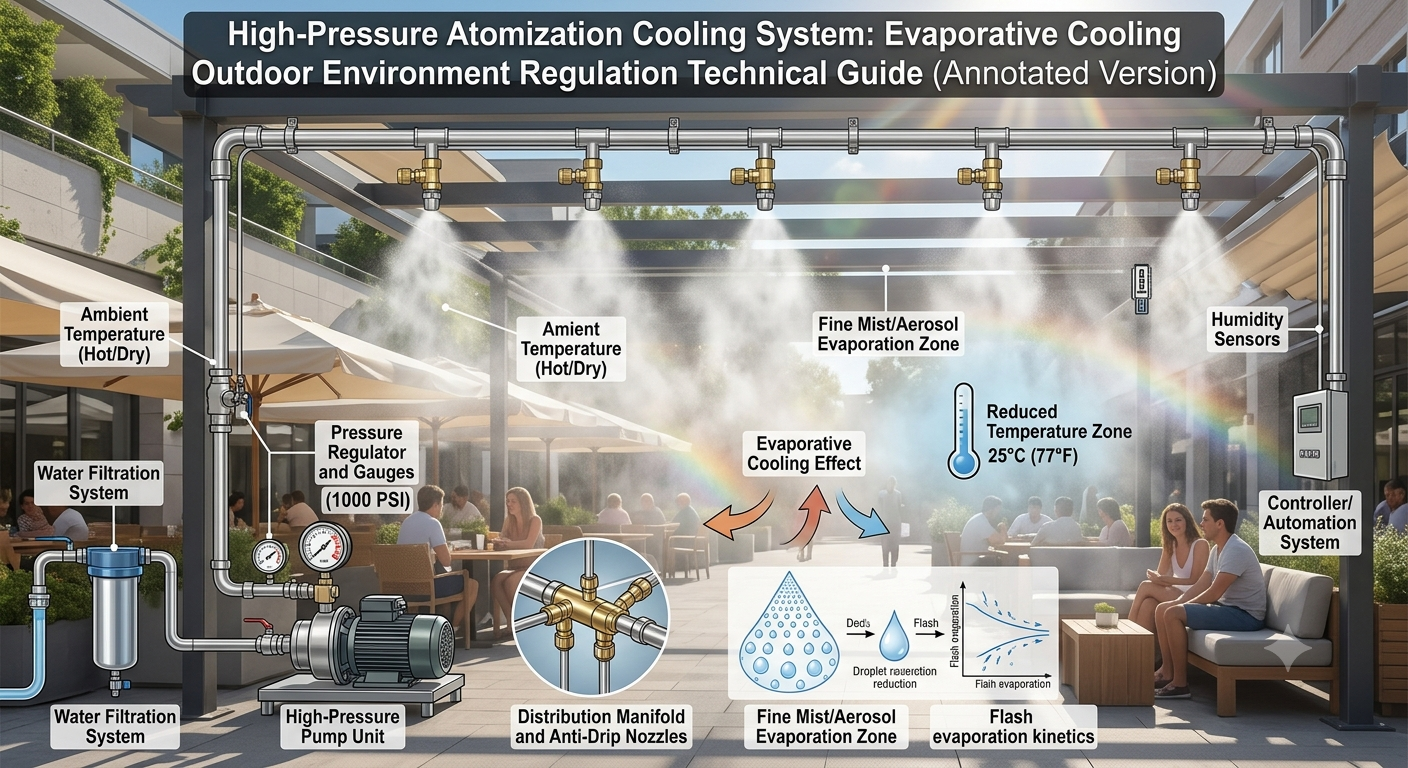
The High-Pressure Micro-Mist Evaporative Cooling System is an evaporative cooling technology specifically designed for outdoor open spaces.
It uses a high-pressure pump to atomize water into ultra-fine mist droplets (Dv50 ≤ 4μm), absorbing heat through the latent heat of water evaporation to achieve local temperature reduction of 3–8°C while creating attractive landscape effects.
It is suitable for semi-open spaces such as commercial plazas, stadiums, and theme parks. It serves as an ideal alternative to traditional air conditioning, which suffers from high energy consumption and limited coverage.
The system integrates multi-parameter sensors and can dynamically adjust misting strategies based on dry-bulb/wet-bulb temperature, wind speed, and solar intensity, achieving sensible heat reduction of 3–8°C. The complete technical solution is provided by Taining Kechuang. It has been successfully applied in multiple domestic stadiums, commercial plazas, and parks, and has served the thermal comfort needs of the Chinese Super League and international events.
Typical Application Scenarios:
Ultra-fine mist droplets are sprayed into the air, absorbing latent heat of vaporization (≈2260 kJ/kg) through evaporation and lowering the dry-bulb air temperature. The theoretical cooling limit is the wet-bulb temperature of the air.
Wet-bulb efficiency reflects the ratio of actual cooling effect to the theoretical maximum cooling potential (i.e., the dry-bulb/wet-bulb temperature difference). Higher efficiency means the misting system is closer to the ideal evaporative cooling state.
Key factors affecting evaporative cooling performance include: ambient dry-bulb temperature, relative humidity, droplet size, spray velocity, and air velocity.
|
Parameter |
Influence Relationship |
Typical Range |
|
Dry-bulb Temperature (°C) |
Higher = greater cooling potential |
30–45 |
|
Relative Humidity (%) |
Lower = more significant cooling effect |
20–80 |
|
Droplet Size (μm) |
Smaller = faster evaporation rate |
≤4 |
|
Spray Velocity (m/s) |
Affects air mixing |
15–25 |
|
Air Velocity (m/s) |
Affects residence time |
0.5–3 |
Typical Conditions: Dry-bulb 35°C, 45% RH, ≤4μm droplets → local cooling of 5–8°C within 3 minutes.
2.1 Comparison of Outdoor Cooling Methods
|
Comparison Dimension |
High-Pressure Misting System |
Compressor Air Conditioning |
Evaporative Air Cooler |
|
Energy Efficiency Ratio (EER) |
≥20 |
2.5–3.5 |
8–12 |
|
Cooling Capacity per Unit Area (W/m²) |
150–250 |
200–300 |
80–120 |
|
Application Range |
Open spaces |
Enclosed spaces |
Local |
|
Initial Investment (USD/m²) |
10–15 |
35–60 |
4–6 |
III. System Composition and Technical Parameters
|
Equipment |
Technical Indicators |
Highlighted Parameters |
|
Precision Filter |
≤5μm (standard), RO optional |
1nm ✓ |
|
High-Pressure Plunger Pump |
7.0–8.5 MPa, flow 8–24 L/min |
✓ |
|
316L Stainless Steel Pipe |
Working pressure ≥20 MPa, wall thickness 1.0–1.5 mm |
✓ |
|
High-Pressure Atomizing Nozzle |
Dv50 ≤4μm, single nozzle flow 80–120 cc/min |
✓ |
|
Intelligent Controller |
Temp/Humidity, wind speed, solar, rain sensor; supports Modbus/BACnet |
✓ |
Nozzles use ruby cores for superior wear resistance compared to ceramic. Taining Kechuang provides complete integrated solutions.
Equipment Dimensions Reference: Typical host unit size is 650–750 mm (L) × 450–550 mm (W) × 500–1250 mm (H), depending on flow rate and power configuration.
4.1 Cooling Load Estimation
|
Area Type |
Recommended Cooling Load (W/m²) |
|
Main Entrance Plaza |
220–250 |
|
Outdoor Dining Area |
200–230 |
|
Commercial Inner Street |
150–180 |
4.2 Nozzle Layout Principles
The system uses PID + fuzzy logic control to dynamically adjust misting duty cycle and zoning modes.
Control Modes: Comfort, Strong Cooling, Anti-Humidity, Landscape, Energy Saving, Rainy Day.
Thermal Comfort Indicators: PMV ±0.5, PPD ≤10%.
6.1 Water Treatment Process
Municipal water → Pre-filter (100μm) → Precision filter (5μm) → Activated carbon/RO (optional) → Water storage → High-pressure pump
6.2 Piping Design
6.3 Drip Prevention and Legionella Control
6.4 Operation & Maintenance Schedule
|
Maintenance Item |
Frequency |
|
Filter cleaning |
Weekly |
|
Nozzle inspection |
Monthly |
|
Pipe network sealing check |
Quarterly |
|
Sensor & pump calibration |
Annually |
|
Winter freeze protection drain |
When temp < 5°C |
7.1 Legionella Prevention System
The high-pressure atomization system adopts a multi-barrier design to ensure public health and safety:
Third-party water quality test reports can be provided to ensure mist water meets Hygienic Standard for Drinking Water (GB5749). In high-traffic areas (stadiums, transport hubs), quarterly microbial sampling at outlets is recommended.
VIII. Typical Application Cases
|
Project |
Area (m²) |
Environmental Conditions |
Cooling Effect (°C) |
Year |
|
Beijing Workers' Stadium |
15,000 |
35°C / 45% RH |
31°C in 3 min (≈4°C drop) |
2023 |
|
Large Domestic Stadium |
12,000 |
32°C / 60% RH |
Local 4–6°C |
2024 |
|
Urban Commercial Plaza |
8,000 |
38°C / 35% RH |
5–7°C |
2024 |
|
Theme Park Visitor Area |
5,000 |
34°C / 70% RH |
3–5°C |
2025 |
Note: The Beijing Workers' Stadium project used an intelligent cold mist cooling system to meet thermal comfort requirements for athletes and spectators during the Chinese Super League and international events. The system has been widely promoted in multiple stadiums, commercial plazas, and parks, with customized designs based on local climate conditions.
Main Suppliers
|
Supplier |
Main Business |
Technical Features |
|
Idrobase Group (Italy) |
High-pressure misting, humidification, cooling |
Industrial/commercial, European market |
|
Fogco (USA) |
High-pressure mist systems, outdoor cooling, landscape mist |
North American restaurants & theme parks |
|
Mee Industries (USA) |
Industrial humidification, climate simulation |
High-precision environmental control |
|
Wavin (Netherlands) |
Plastic piping, underfloor heating/cooling |
Indoor circulation cooling & auxiliary |
|
Geberit (Switzerland) |
Sanitary, drainage, rainwater systems |
Comprehensive building system integration |
|
Taining Kechuang (China) |
High-pressure micro-mist evaporative cooling, rainwater management |
Large outdoor open spaces & landscapes |
|
Dimension |
Overall Observation |
|
Core Technology |
High-pressure micro-mist evaporative cooling, droplet size 3–5μm, cooling via water evaporation |
|
Intelligent Control |
Temperature/humidity logic, multi-vendor integration of sensors + PLC + BMS |
|
Application Scenarios |
Primarily outdoor open spaces: commercial plazas, landscapes, stadiums, parks |
|
System Integration |
Some provide full solutions; others supply only core misting equipment |
|
Energy Efficiency & Low Carbon |
EER ≥15 (up to 20+ for premium systems), meets green building and low-carbon requirements |
International Certification Note: Core components (high-pressure pumps, nozzles, controllers) from mainstream suppliers have CE, UL, ISO 9001, and ISO 14001 certifications. They operate stably across global power systems (110V/220V/380V, 50/60Hz).
|
Certification System |
Scoring Points |
|
LEED v4.1 |
SS Credit: High-reflectance roofing + evaporative cooling to reduce heat island effect WE Credit: Rainwater harvesting for landscape misting |
|
WELL v2 |
Thermal Comfort: Outdoor microclimate regulation Mind/Community: Natural cloud/fog landscape effects |
|
Low-Carbon & High Efficiency |
EER ≥20; most cooling provided by water latent heat of evaporation |
Q1: Why must droplet size be controlled to ≤4μm? A: Micro-mist droplets evaporate rapidly in air and completely evaporate before reaching the ground, preventing slippery surfaces and wet clothing.
Q2: How to prevent nozzle clogging? A: Multi-stage water filtration (≤5μm), automatic nozzle flushing on first startup, ruby or ceramic nozzle cores, and optional UV-C sterilization module.
Q3: Does the system consume a lot of energy? A: Cooling is mainly provided by the latent heat of water evaporation. EER ≥20. Power consumption is only 1/3 to 1/4 of traditional compressor air conditioning.
Q4: Can the outdoor cooling effect be quantified? A: Yes. Under 35°C dry-bulb and 45% RH, local temperature drop of approximately 5–8°C can be achieved within 3 minutes.
Q5: Can the system integrate with building management or intelligent control platforms? A: Yes. It supports Modbus RTU/TCP and BACnet protocols and can interface with Building Management Systems (BMS) for remote monitoring and zoned control.
Q6: How does the system ensure public health? A: Multi-stage filtration + UV sterilization + anti-drip design + automatic pipe draining. Water quality meets GB17324 standards, effectively controlling Legionella risk.
Authoritative References
Data Note: All technical parameters and project data cited in this document come from public sources and field measurements. Data is current as of March 2026. Project selection should be based on comprehensive assessment of local climate, geology, and the latest standards.