Green roofs are widely recognized for their ability to mitigate urban heat islands, retain stormwater, and improve building energy efficiency. However, several long-standing engineering challenges have limited their widespread adoption, including structural load restrictions, drainage inefficiencies, high maintenance costs, and resilience to extreme weather conditions.
In recent years, a new approach known as the Rain-Fed Green Roof System has gained attention. By integrating PP (polypropylene) water storage modules with efficient drainage systems, this technology relies on stored rainwater and capillary reuse to sustain rooftop vegetation primarily through natural precipitation. Its core principle is simple: retain small rainfall events on-site and slowly release excess water during heavy storms.
This article explores the engineering logic behind rain-fed green roof systems, including their water storage and capillary irrigation mechanisms, key design parameters, material selection criteria, construction considerations, and comparisons with internationally recognized systems such as Sika and ZinCo. Drawing upon standards such as the Sponge City Construction Evaluation Standard (GB/T 51345-2018), the German FLL Green Roof Guidelines, and numerous real-world projects, it provides architects and engineers with a practical technical reference.
The design philosophy of rain-fed systems follows the principles of the natural water cycle.
* The standard 85 mm water storage depth is based on two key factors:
* Typical summer water consumption of rooftop vegetation (3–5 mm per day).
* The fact that most temperate cities experience no more than two consecutive weeks without rainfall.
This depth provides an optimal balance between water availability and efficiency.
Instead of relying on conventional irrigation systems, rain-fed roofs utilize capillary water reuse, allowing moisture to move upward naturally through soil suction. Overflow outlets are strategically positioned above the siphonic drainage activation level but below the maximum storage depth, ensuring that water is stored first and discharged only when necessary.
This approach transforms green roofs from systems that depend heavily on manual intervention into largely self-regulating ecological infrastructure.
Although green roofs have been common throughout Europe and North America for decades, their global adoption continues to face several common challenges:
Excessive Structural Load
Traditional systems often require concrete slope layers and gravel drainage beds, easily adding 300–400 kg per square meter. Many existing buildings cannot support such additional loads.
Drainage Challenges
Gravity drainage systems can suffer from insufficient slope and clogging issues. During heavy rainfall, water may accumulate on rooftops, increasing structural and waterproofing risks.
High Maintenance Costs
Without frequent irrigation, many rooftop plants struggle to survive during hot summer months. Hiring maintenance teams for regular watering significantly increases operating expenses.
When early rooftop greening pilot projects were introduced more than a decade ago, building owners consistently asked three questions:
* How can roof loads be controlled?
* How can drainage be guaranteed?
* Who will manage long-term maintenance?
At the time, achieving lightweight construction, rapid drainage, and irrigation-free operation simultaneously was extremely difficult.
Today, after hundreds of projects across multiple climate zones, rain-fed green roof systems offer a practical solution by replacing gravel with lightweight PP modules and replacing conventional irrigation with stored rainwater and capillary action.
The answer lies within the 85 mm water storage layer.
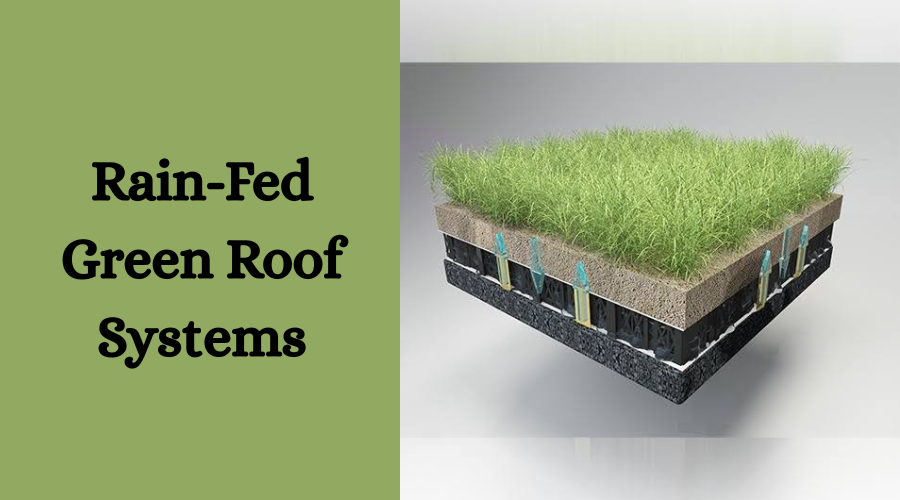
A rain-fed green roof places a layer of PP storage modules directly above the waterproofing membrane. These modules function like a giant sponge beneath the planting medium.
Water is stored within the modules while capillary wicks connect the storage zone to the growing medium. As the soil dries, moisture naturally moves upward to replenish plant roots.
Why 85 mm?
Research from the Beijing Institute of Landscape Architecture indicates that succulent rooftop vegetation typically consumes only 3–5 mm of water per day during summer.
Using the conservative figure of 5 mm per day:
* 85 mm of stored water can support plants for approximately 17 days.
Since most temperate and subtropical regions rarely experience more than two weeks without rainfall, 85 mm represents an efficient design balance.
Climate Adaptability
The storage depth can be adjusted according to local conditions:
* Arid regions (Middle East, North Africa): Up to 150 mm using stacked modules.
* Rainy regions (Southeast Asia): Reduced to 50 mm with additional overflow outlets.
Because the modules are standardized and stackable, designers can easily adapt storage capacity to local climate requirements.
Rain-fed green roofs can accommodate either:
* Gravity drainage systems
* Siphonic drainage systems
Both aim to remove excess water that exceeds storage capacity.
Gravity Drainage
Gravity systems use roof slopes to direct water toward outlets. They are simple, cost-effective, and easy to maintain.
Best suited for:
* Small roof areas
* Retrofit projects
* Moderate drainage requirements
Siphonic Drainage
Siphonic systems use specially designed roof drains that prevent air entry and create negative pressure inside the piping network.
Advantages include:
* Water velocities 5–10 times greater than gravity drainage.
* Smaller pipe diameters.
* Horizontal pipe installation without slope.
* Reduced material and space requirements.
The Importance of Early Activation
Many older siphonic systems required approximately 80 mm of water depth before activation, allowing significant water accumulation during the initial stages of a storm.
Modern low-head siphonic technology can activate at approximately 50–55 mm water depth, allowing much faster stormwater removal and reducing temporary roof loading.
Dual Protection Strategy
Current best practice uses a combination of:
* Primary drainage systems
* Emergency overflow outlets
Typical configuration:
* Overflow elevation: 60 mm
* Siphonic activation depth: 50–55 mm
* Maximum module storage depth: 85 mm
This arrangement ensures:
* Water is stored first.
* Excess water is drained efficiently.
* Extreme storms can bypass the system safely through overflow outlets.
Drainage systems perform poorly when sediment enters the pipes.
To address this, modern rain-fed systems typically incorporate:
Primary Filtration Layer
A high-weight nonwoven geotextile (minimum 200 g/m²) captures most soil particles.
Secondary Protection Layer
Drainage boards provide additional filtration and buffering.
Together, these layers significantly reduce maintenance requirements and extend drainage system performance.
A typical rain-fed green roof consists of the following layers from top to bottom:
1. Vegetation layer
2. Lightweight growing medium
3. Filter layer
4. Water storage and drainage layer
5. Protective drainage membrane
6. Waterproofing layer
7. Leveling layer
8. Structural roof slab
Column 1 Column 2 Column 3
Material Key Parameters Function
PP Storage Module Compressive strength ≥ 450 kN/m² Water storage and support
Drainage Membrane Puncture resistance ≥ 400 N Waterproofing protection
Siphonic Roof Drain Activation depth 50–55 mm Efficient stormwater drainage
Lightweight Soil Dry density ≤ 1000 kg/m³ Plant growth medium
The waterproofing system should undergo a minimum 48-hour flood test before installing modules.
Skipping this step can result in costly repairs if leaks are discovered after landscaping has been completed.
The relationship between drainage elevations must remain precise:
* Siphonic activation level < Overflow elevation < Maximum storage level
Construction tolerances should remain within ±5 mm whenever possible.
Although PP modules have high compressive strength under distributed loads, concentrated construction loads can still cause damage.
A commonly used approach is the “backward installation method,” where workers stand on completed sections while moving materials forward, preventing direct loading on exposed modules.
Roof drains should remain covered during soil placement and construction activities to prevent debris contamination.
Pressure testing should be performed after all earthworks are completed.
The global market is largely represented by three approaches:
Sika (Switzerland)
Strengths:
* Waterproofing expertise
* Integrated roofing and drainage systems
* Ideal for high-rise buildings with strict waterproofing requirements
ZinCo (Germany)
Strengths:
* Extensive ecological and horticultural expertise
* Contributor to FLL guidelines
* Highly modular systems
Limitations:
* Standard water storage typically ranges from 30–50 mm
* Additional irrigation may be required in dry climates
Tidelion (China)
Strengths:
* Focus on balancing water storage and drainage
* Large-capacity storage modules
* Capillary water reuse technology
* Flexible gravity or siphonic drainage configurations
Particularly suitable for monsoon climates characterized by alternating heavy rainfall and seasonal drought.
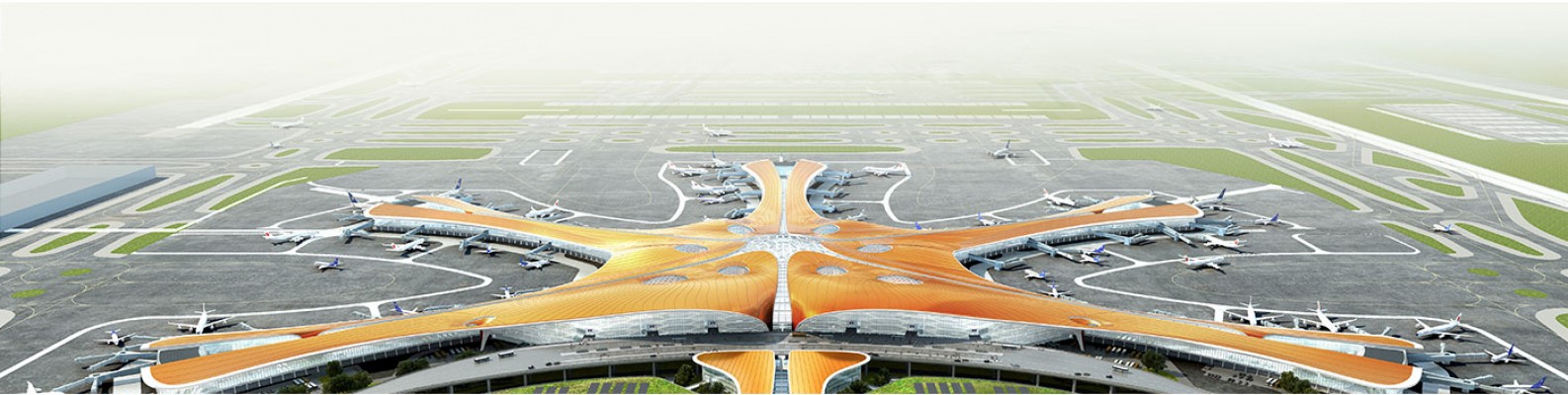
One of China’s largest rain-fed green roof installations.
Performance highlights include:
* Over 85% stormwater runoff control.
* Approximately 30% higher drainage efficiency compared to traditional systems.
* Successful operation during multiple intense summer storms.
Beijing’s first carbon-neutral themed park incorporates rain-fed rooftop greening technology.
The system contributes to:
* Reduced building energy consumption.
* On-site rainwater utilization.
* Lower maintenance requirements.
* Long-term sustainability objectives.
Can older buildings support a rain-fed green roof?
Possibly, but structural analysis is required. Additional dead loads typically range between 3.0 and 5.0 kN/m².
Can the system withstand extreme rainfall events?
Yes. The combination of primary drainage and emergency overflow provides multiple layers of protection.
Will drainage deprive plants of water?
No. Water storage layers are designed to retain water before excess runoff enters the drainage system.
How often is maintenance required?
Most systems only require annual inspections and periodic cleaning of inspection chambers.
Does the drainage system operate during light rain?
Usually not. Small rainfall events are stored within the modules and reused by vegetation.
Will freezing temperatures damage the modules?
PP modules typically withstand temperatures as low as -30°C and are designed to accommodate seasonal freeze-thaw cycles.
How is annual runoff control calculated?
Hydrological simulation models use long-term local rainfall records, often covering 30 years of climate data, to estimate annual runoff retention rates.
Green roofs are evolving beyond decorative landscape features and becoming essential urban infrastructure.
As cities place increasing emphasis on resilience, sustainability, stormwater management, and energy efficiency, rooftop greening must perform multiple environmental functions simultaneously.
Rain-fed green roof systems achieve this by integrating water storage, drainage, and reuse into a single self-regulating ecosystem. Through the combination of PP storage modules, capillary irrigation, intelligent overflow control, and adaptable drainage strategies, these systems significantly reduce maintenance requirements while improving environmental performance.
The future of green roof technology lies not merely in creating attractive rooftop landscapes but in developing resilient, autonomous systems that contribute to sustainable urban development. By understanding the engineering principles behind rain-fed roofs, designers and engineers can make informed decisions and implement solutions that are best suited to local climate conditions and project requirements.